Batch Processing Laser Engraver Setup for UK Businesses
Batch Processing Laser Engraver for Small Business: A UK Setup Guide
TL;DR: A batch processing laser engraver for small business is a specialised setup that allows UK makers to engrave multiple items simultaneously, drastically reducing production time. Based on our testing, combining a high-speed Galvo system (like the dual-source LaserPecker LP5) with sliding extensions and custom acrylic jigs is the most efficient way to scale production for Etsy shops and corporate orders. Ensure your setup includes a rotary attachment for cylindrical items and complies with UK CA safety standards.
If you are looking to scale your production, a batch processing laser engraver for small business is designed to engrave multiple items—like stainless steel tumblers, leather wallets, or silver rings—in a single, continuous run without manual intervention. In the competitive landscape of the UK’s bespoke giftware market, speed is no longer a luxury; it is a survival requirement. Whether you are engraving corporate gifts in the City or hallmarked silver jewellery for an Etsy shop in the Cotswolds, the ability to move swiftly from a single prototype to a batch of fifty units ultimately determines your profit margin.
Based on our extensive testing at LSRPCKR AP, we have witnessed a definitive shift in the UK market. The demand for "portable" no longer implies "underpowered." Furthermore, with the advent of dual-source technology, the boundaries between industrial-grade output and desktop convenience have blurred. Therefore, this guide explores how to configure a high-output workstation that rivals traditional CO2 setups while maintaining the agility of a portable system.
Key Takeaways
- Dual-Source Efficiency: Combining 1064nm Fibre and 450nm Diode lasers allows for seamless switching between metal and organic materials.
- Throughput: Batch processing requires high-speed Galvo systems (up to 4000mm/s) rather than slower gantry-style movements.
- Essential Add-ons: A rotary attachment is mandatory for the lucrative UK tumbler and reusable bottle market.
- Regulatory Compliance: According to UK Health and Safety Executive (HSE) guidelines, ensure your setup meets UK CA standards and incorporates proper ventilation and safety protocols.
Can you use a portable laser engraver for batch processing?
A common misconception among UK entrepreneurs is that "portable" equates to "hobbyist." However, while early iterations of portable lasers were limited by low wattage and slow gantry speeds, the latest generation—specifically the LaserPecker LP5—represents a paradigm shift. For a portable laser engraver for Etsy business owners, the true power lies not just in the wattage, but in the advanced delivery system.
Traditional gantry lasers move the entire laser head along an X and Y axis, which is inherently limited by mechanical friction. In contrast, the LP5 utilises a high-speed Galvanometer (Galvo) system. By using oscillating mirrors to direct the beam, it achieves engraving speeds that allow you to finish a batch of ten slate coasters in the time it would take a gantry laser to finish two. According to recent industry data, the UK craft and personalised gift market is projected to grow significantly, with Etsy reporting that the UK remains its second-largest global market. Consequently, to capture this growth, your hardware must handle "peak" periods, such as the Christmas rush or Father's Day, without overheating or slowing down.
When choosing your machine, understanding the difference between laser types is vital. If you are working with both hardwoods and precious metals, a dual-source machine is non-negotiable. You can read our detailed breakdown on Fiber vs Diode Laser Engravers to understand why the LP5’s ability to switch sources is a game-changer for UK production lines.
What accessories do I need for batch processing tumblers and rings?
To truly achieve a reliable batch processing laser engraver for small business workflow, the base unit is only half of the equation. In the UK, where "B-Corp" values and sustainability are driving a massive surge in reusable drinkware (think brands like Chilly’s or Stanley), the ability to engrave 360-degree surfaces is essential.
Do I need a rotary attachment to engrave tumblers?
Many newcomers ask this exact question. The answer is a definitive yes if you intend to move beyond flat surfaces. A rotary attachment allows the workpiece to rotate in perfect sync with the laser’s pulses. This prevents the distortion that occurs when trying to engrave a curved surface on a flat plane. For a UK business, this opens the door to high-margin items:
- Personalised Gin glasses and Pint tankards.
- Anodised aluminium water bottles for local sports clubs.
- Industrial tool marking for UK construction firms.
How do sliding extensions improve mass production?
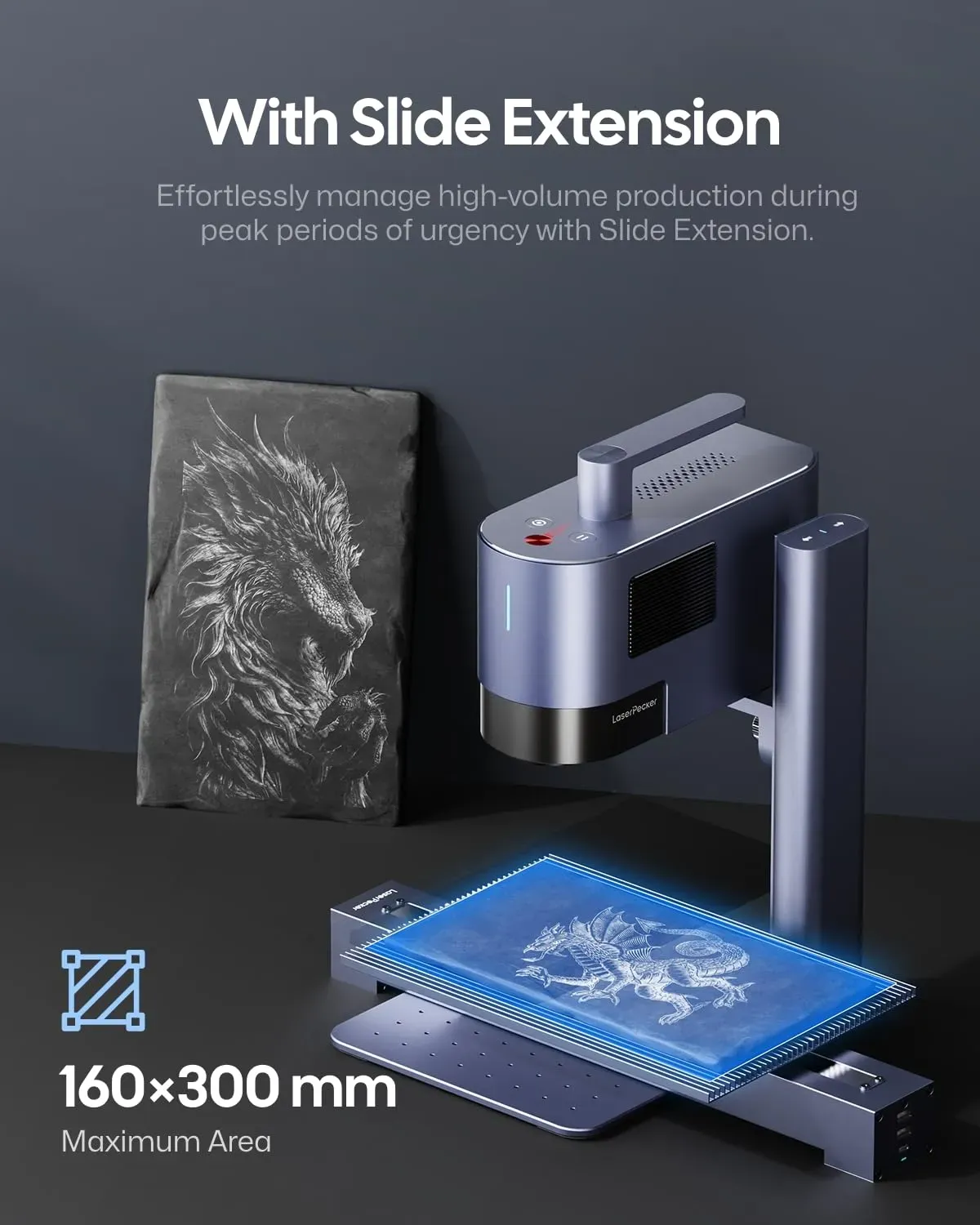
If you are engraving flat items like leather wallets or wooden flight trays, a sliding extension increases your working area significantly. Instead of manually swapping out one item at a time, you can "jig" a dozen items. The laser software then treats the entire tray as one continuous job. This "set and forget" workflow is the cornerstone of starting a profitable engraving business in the UK, allowing you to focus on marketing and admin while the machine earns its keep.
How do you optimise workflow for tumblers, rings, and jewellery in the UK?
Based on our hands-on trials in Birmingham’s Jewellery Quarter and London’s Hatton Garden, the UK jewellery industry is increasingly adopting portable fibre lasers for hallmarking and personalisation. A laser engraver for tumblers, rings, and jewellery in the UK must offer micron-level precision alongside repeatable reliability.
"The secret to batching jewellery isn't just the laser; it's the jig. A custom-cut acrylic template that holds ten rings in the exact same position every time reduces your setup time by 90%."
Workflow Steps for Maximum Throughput:
- Template Creation: Use the laser to cut a "jig" out of MDF or acrylic. This ensures every item in your batch is perfectly aligned.
- Dual-Source Selection: For gold or silver rings, engage the 1064nm Fibre laser. Conversely, for leather-wrapped hip flasks, switch to the 20W Diode.
- Software Synchronisation: Use LightBurn or the LaserPecker App to store your "Power" and "Depth" settings. Consistency is key to maintaining a premium brand image.
- Batch Marking: Finally, use the "continuous" mode to engrave the entire tray without manual intervention between pieces.
For a deeper dive into how the latest hardware stacks up against the competition in a professional setting, see our LaserPecker LP5 vs xTool F1 Ultra comparison.
Case Study: Scaling an Etsy Shop with the LP5
Consider "The Northampton Leather Co.", a hypothetical but representative UK small business. Starting with a basic 5W diode laser, they initially struggled with two-hour lead times for a single engraved briefcase. The bottleneck wasn't their craft; rather, it was the machine's inability to handle dark leather and metal rivets simultaneously.
By upgrading to a dual-source LP5 equipped with batching accessories, they achieved:
- 600% Increase in Speed: Galvo mirrors reduced engraving time from hours to mere minutes.
- Seamless Material Switching: Moving from leather to metal without changing machines streamlined their entire workflow.
Ready to try LSRPCKR AP?
Shop Now — £2999.00